
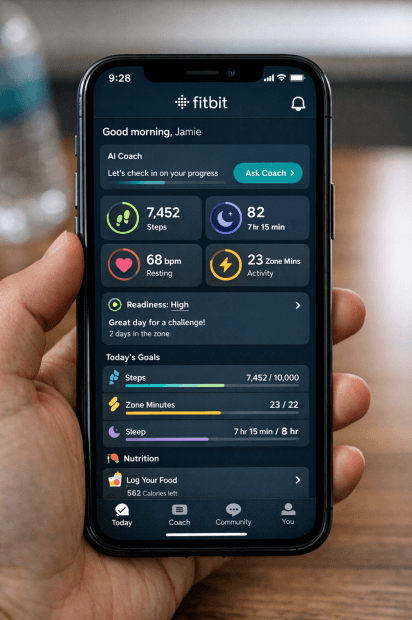
Google has expanded its AI-powered Fitbit health coach to iPhone users, widening access to personalised wellness insights and signalling a deeper push into consumer health technology.
The feature, integrated within the Fitbit app, uses generative artificial intelligence to interpret activity metrics, sleep patterns and heart-rate data. It then provides tailored recommendations designed to help users adjust daily routines, exercise intensity and recovery habits.
The move extends capabilities that were previously limited to Android devices, positioning the company more competitively within the cross-platform health ecosystem. By making the AI health coach available on iOS, Google enters more directly into a market segment long dominated by Apple’s tightly integrated hardware and software model.
AI-driven health tools mark a shift from passive tracking toward contextual guidance. Rather than simply displaying steps or calorie counts, the Fitbit system analyses patterns over time and delivers conversational prompts that adapt to user behaviour.
Industry analysts say the shift reflects a broader transformation across digital health services, where algorithms increasingly interpret data streams from wearable devices. These tools aim to provide actionable insight rather than static dashboards, narrowing the gap between consumer wellness products and more advanced clinical analytics.
The development also reflects growing competition in the global wearable market, where technology companies are racing to differentiate through software intelligence rather than hardware alone.
As AI capabilities expand, questions around privacy and data security remain central. Health metrics are considered sensitive personal information in many jurisdictions, and regulators continue to scrutinise how such data is processed, stored and shared.
Google has stated that user health data remains subject to its privacy policies and that personalised insights are generated within controlled systems. The company maintains that health information is not used for advertising purposes.
However, digital rights groups have repeatedly emphasised the need for transparent governance frameworks, particularly as generative AI systems rely on increasingly complex data modelling. Experts note that consumer trust will depend not only on technical safeguards but also on clear communication about how data informs AI-generated recommendations.
The expansion of AI into everyday health tracking underscores a broader convergence between technology and preventative care. While consumer apps are not substitutes for medical diagnosis, they are increasingly positioned as tools that support behavioural change and early awareness.
Market researchers project sustained growth in AI-enabled wellness platforms over the coming years, driven by demand for personalised digital services. For major technology firms, health represents both a strategic growth area and a reputational test, as public sensitivity to data protection continues to intensify.
By extending its AI health coach to iPhone users, Google reinforces its ambition to play a central role in the next phase of digital wellbeing. The development reflects a wider industry transition toward intelligent, responsive systems designed to embed health monitoring more deeply into daily life.
From breaking news to thought-provoking opinion pieces, our newsletter keeps you informed & engaged.






Lorem ipsum dolor sit amet, consectetur adipiscing elit. Suspendisse varius enim in eros elementum tristique. Duis cursus, mi quis viverra ornare, eros dolor interdum nulla, ut commodo diam libero vitae erat. Aenean faucibus nibh et justo cursus id rutrum lorem imperdiet. Nunc ut sem vitae risus tristique posuere.