
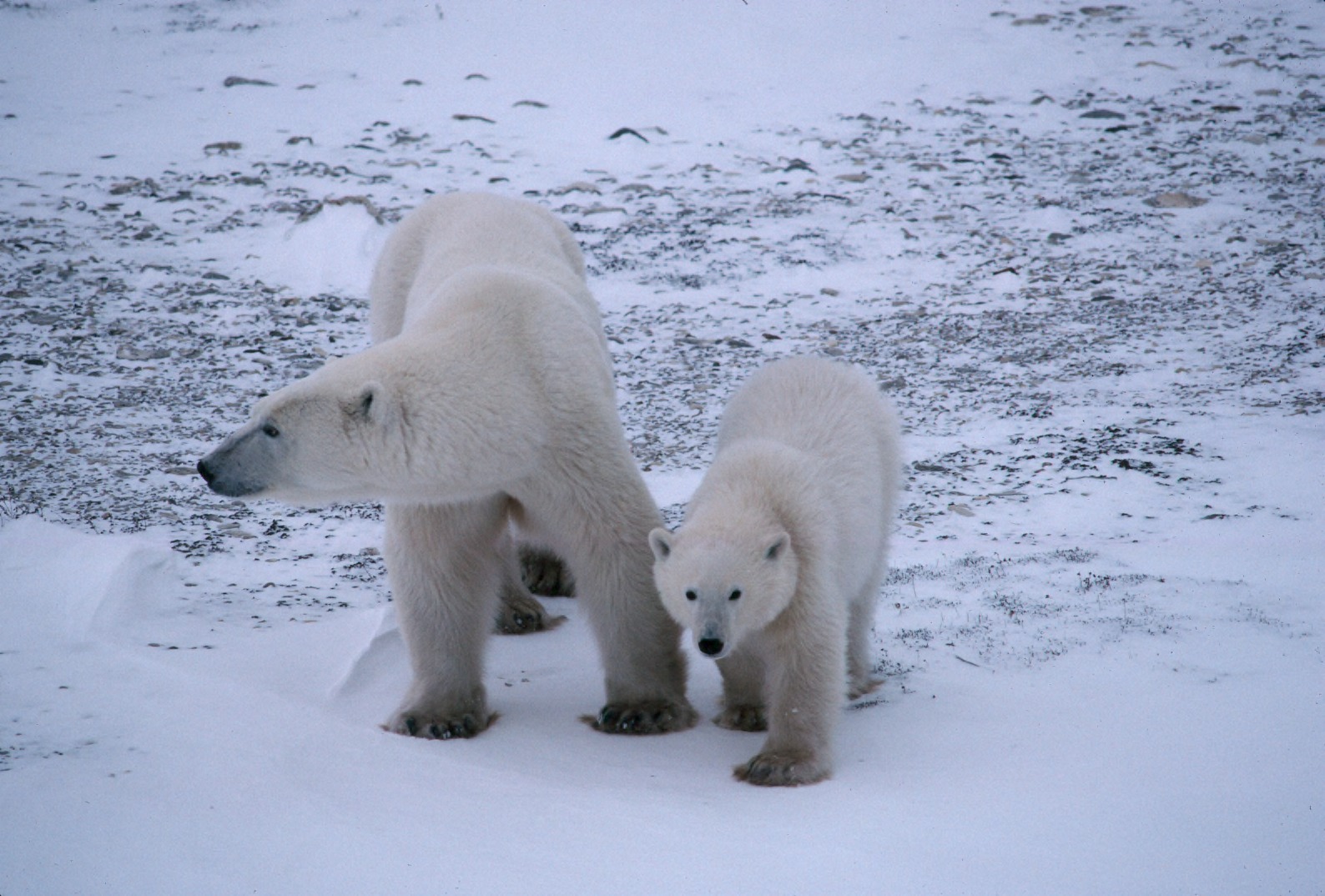
Researchers in northern Canada have documented a rare instance of a female polar bear (Ursus maritimus, identified as X33991) caring for a cub that is not her biological offspring, based on observations recorded during long-term monitoring in the Western Hudson Bay region near Churchill, Manitoba.
Polar bears are typically solitary animals, and females generally raise only their biological offspring. Maternal care extends for up to two to two-and-a-half years and involves nursing, protection, and guidance through seasonal migration and hunting. As a result, confirmed cases of cub adoption are uncommon due to the significant energy demands involved.
According to researchers involved in Arctic polar bear monitoring programs, bear X33991 was first recorded earlier in the year emerging from her maternity den with a single cub. During a later survey conducted several months afterward, she was observed traveling with two cubs of similar age. One of the cubs did not match existing tagging and identification records.
Based on visual identification, tagging history, and tracking data, scientists determined that the second cub was not her biological offspring. Both cubs were estimated to be approximately 10 to 11 months old at the time of observation. Genetic analysis is ongoing to further document lineage and confirm individual identification.
Within the Western Hudson Bay subpopulation—one of the most extensively studied polar bear populations globally—researchers have recorded approximately 13 confirmed cases of cub adoption over roughly 45 years of monitoring, involving more than 4,600 individual bears.
Researchers have stated that the circumstances leading to the cub’s separation from its biological mother remain unknown. No conclusions have been drawn regarding the cause of the adoption.
While Arctic environmental conditions are known to influence polar bear populations broadly, scientists have indicated that there is currently no evidence directly linking this specific adoption event to environmental or climate-related factors. The observation is being documented as part of ongoing research into population dynamics, maternal behavior, and survival rates.
Polar bears are listed as Vulnerable by international conservation authorities. Long-term monitoring programs in regions such as Western Hudson Bay continue to provide data used to assess population health, reproductive success, and cub survival.
Researchers will continue to observe bear X33991 and both cubs through established field studies, contributing to broader scientific efforts to understand polar bear behavior in the Arctic.
From breaking news to thought-provoking opinion pieces, our newsletter keeps you informed & engaged.




Lorem ipsum dolor sit amet, consectetur adipiscing elit. Suspendisse varius enim in eros elementum tristique. Duis cursus, mi quis viverra ornare, eros dolor interdum nulla, ut commodo diam libero vitae erat. Aenean faucibus nibh et justo cursus id rutrum lorem imperdiet. Nunc ut sem vitae risus tristique posuere.