
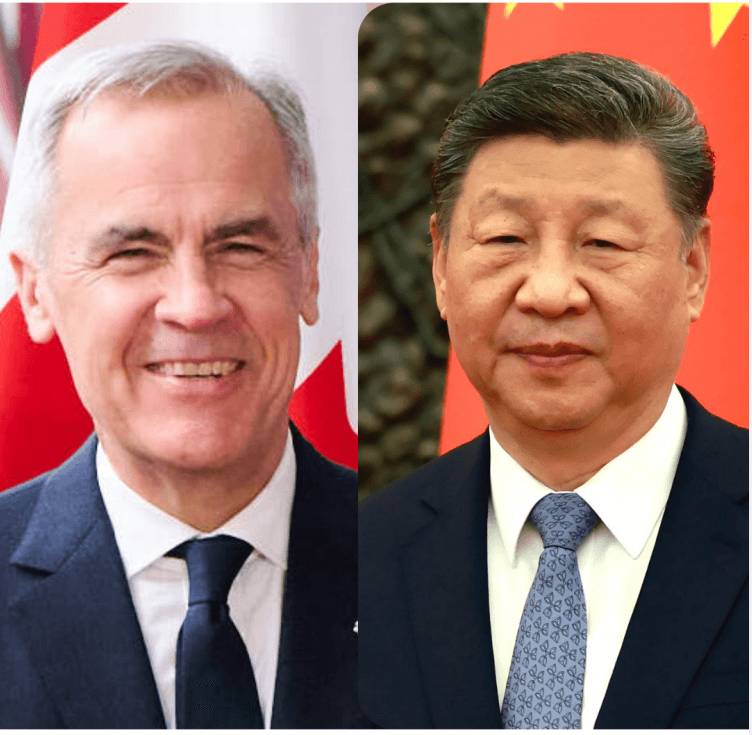
In a significant shift in North American economic policy, Canadian Prime Minister Mark Carney announced on Friday that Canada and China are forging a “new strategic partnership” aimed at recalibrating bilateral ties to adapt to what Ottawa described as “new global realities.” The announcement, made during Carney’s visit to Beijing — the first by a Canadian prime minister in nearly a decade — underscores Canada’s bid to diversify its trade relationships and deepen market access beyond its historic reliance on the United States.
Carney and Chinese President Xi Jinping jointly outlined a framework intended to expand cooperation in key economic sectors, reduce longstanding barriers to trade and attract new investment across energy, agriculture, finance, and advanced technology. Both leaders framed the pact as a pragmatic response to persistent global trade tensions, with Canada seeking new avenues for growth amid tariff disputes and broader geopolitical uncertainty.
During the high-level dialogue in Beijing, Carney emphasised that the partnership is designed to “deliver stability, security and prosperity for people on both sides of the Pacific” by building on historic economic ties and expanding future opportunities. The prime minister framed the agreement as a departure from traditional policy approaches, emphasising economic diversification and resilience in the face of global market volatility.
A cornerstone of the emerging agreement is a trade deal that cuts tariffs on key goods — most notably, Canada agreed to lower its 100 per cent tariff on Chinese electric vehicles (EVs) in exchange for China reducing steep duties on Canadian agricultural exports such as canola seed, lobster and peas. Tariffs on canola, a crop central to Canada’s agribusiness sector, are expected to fall from roughly 85 per cent to around 15 per cent by March 2026, unlocking significant export potential for Canadian producers.
Under the initial arrangement, up to 49,000 Chinese EVs will be imported annually into Canada at preferential tariff rates, with plans to gradually expand this cap to 70,000 over five years — a move anticipated to stimulate competition in Canada’s automotive market and pave the way for potential Chinese joint-venture investment in domestic vehicle manufacturing.
Ottawa’s announcement has already registered positive responses from financial markets, with futures for the S&P/TSX Composite Index rising as investors anticipate broader economic benefits from strengthened ties with China, particularly in sectors such as energy and agriculture. Analysts suggest that tariff reductions and new cooperation frameworks could ease pressure on Canadian exporters, who have faced significant headwinds from U.S. tariffs reimposed under the Trump administration.
Chinese officials echoed Canada’s emphasis on mutual economic benefit, signalling Beijing’s willingness to expand cooperation in clean energy, digital technology, advanced manufacturing and finance — sectors seen as long-term drivers of global growth. These commitments align with China’s broader strategy to foster new growth drivers and deepen economic integration with partners willing to engage on pragmatic, market-oriented terms.
The architecture of the renewed partnership reflects Canada’s strategic calculus to reduce overdependence on the U.S. market, which still absorbs the majority of Canadian exports but has also been a source of friction due to recent tariff disputes. By contrast, China — Canada’s second-largest single-country trading partner — has been seen as an under-leveraged market whose potential could be unlocked through targeted tariff relief and cooperative economic policies.
Although Ottawa remains a strong U.S. ally, Carney’s visit signals a rebalancing of economic priorities in response to evolving global trade dynamics. The prime minister has stated his ambition to double Canada’s exports to non-U.S. partners by 2030, a broader strategy that positions China — alongside Europe, India and other emerging markets — as an integral element of Canada’s future trade landscape.
Despite the positive developments, analysts caution that deep-seated issues — including cybersecurity concerns, differing regulatory regimes and lingering mistrust from past diplomatic spats — could temper the pace of progress. Previous episodes in Canada–China relations — such as the 2018 detention of two Canadian citizens in China and subsequent retaliatory tariffs — underscore the fragility of Sino-Canadian ties and the geopolitical sensitivities that continue to shape them.
Nonetheless, the strategic partnership outlined in Beijing represents a meaningful realignment of economic policy, one that prioritises trade diversification, investment growth and pragmatic cooperation in an era marked by shifting global power dynamics.
From breaking news to thought-provoking opinion pieces, our newsletter keeps you informed & engaged.






Lorem ipsum dolor sit amet, consectetur adipiscing elit. Suspendisse varius enim in eros elementum tristique. Duis cursus, mi quis viverra ornare, eros dolor interdum nulla, ut commodo diam libero vitae erat. Aenean faucibus nibh et justo cursus id rutrum lorem imperdiet. Nunc ut sem vitae risus tristique posuere.