
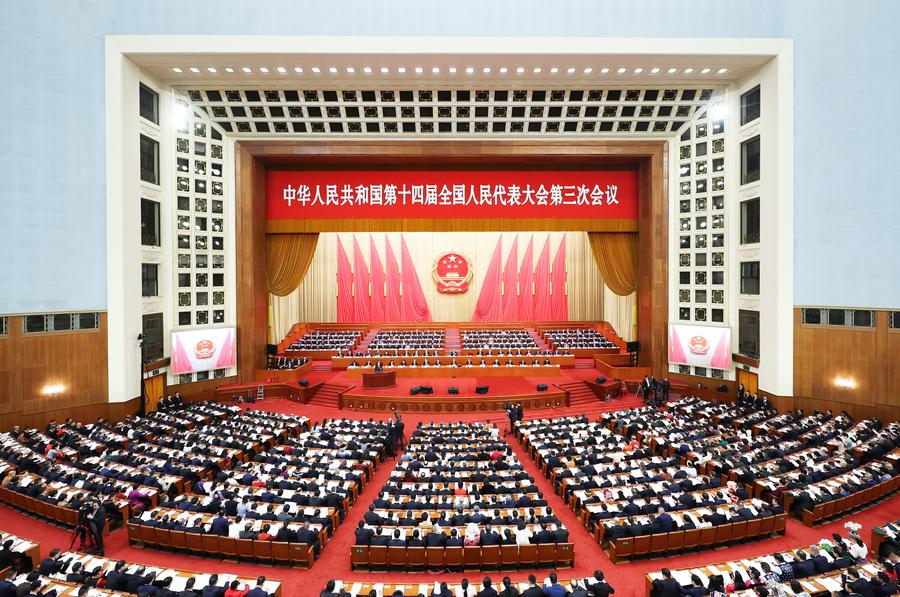
China’s annual Two Sessions have opened in Beijing, marking the country’s most important political gathering of the year. Over the next one to two weeks, thousands of delegates and advisers from across mainland China, Hong Kong and Macau will convene to review legislation, approve budgets and formalise policy priorities for 2026.
The meetings combine the annual sessions of the Chinese People's Political Consultative Conference and the National People's Congress, both held at the Great Hall of the People. The CPPCC opened on March 4, followed by the NPC on March 5.
The CPPCC is a political advisory body composed of more than 2,000 members drawn from non-Communist political parties, business groups, academia, ethnic minorities and other sectors. While it does not hold legislative power, it provides recommendations and policy proposals that reflect broader social and economic concerns.
Legislative authority rests with the NPC, established in 1954 as China’s highest organ of state power under the constitution. It comprises nearly 3,000 delegates representing provinces, autonomous regions, municipalities, central government institutions and the armed forces. Delegates serve five-year terms.
The NPC has the authority to enact and amend laws, approve the national budget, endorse economic development plans and confirm senior state appointments. In practice, legislation presented during the session is typically approved, reflecting decisions shaped within Communist Party leadership structures before being submitted to the congress.
Between annual meetings, the NPC Standing Committee, a smaller body elected from among delegates, exercises legislative functions on a continuing basis.
The central moment of the NPC gathering is the Government Work Report delivered by Premier Li Qiang. The report reviews the previous year’s performance and outlines economic and political priorities for the year ahead.
The annual gross domestic product growth target will be announced, alongside fiscal policy measures, defence spending figures and other budgetary allocations. Legislative measures and personnel changes are also confirmed during the session.
In previous years, the Two Sessions have formalised major political developments. In 2023, delegates confirmed President Xi Jinping’s third term in office. In 2020, lawmakers advanced the national security framework later implemented in Hong Kong.
Although the proceedings are highly structured, the policy language and emphasis within official reports are closely analysed for signals about leadership priorities.
This year’s sessions are significant as delegates review the framework of the 15th Five Year Plan covering 2026 to 2030. The plan sets medium-term goals for economic development, industrial policy and technological advancement.
Draft priorities include boosting domestic consumption, strengthening advanced manufacturing and expanding investment in strategic technologies such as artificial intelligence, quantum technology and nuclear fusion. Policymakers are also focused on supply chain resilience and reducing external economic vulnerabilities.
The economic growth target for 2026 will draw particular attention. In recent years, China has set targets at around 5 percent. Any adjustment would reflect the leadership’s approach to balancing expansion with structural reform amid property sector pressures and uneven domestic demand.
Lawmakers are also expected to deliberate on an ethnic unity law and approve an Ecological and Environmental Code addressing pollution control and low-carbon development.
The sessions take place against the backdrop of recent changes within the leadership of the People’s Liberation Army. Several senior military officials have been removed from their posts or stripped of delegate status in recent months amid anti-corruption investigations. Delegate attendance during the sessions is therefore being closely observed.
While the Two Sessions do not function as a competitive parliamentary process, they remain central to understanding China’s governance direction. The meetings provide formal endorsement of policy decisions and offer insight into economic management, legislative priorities and political consolidation.
As China enters a new Five Year Plan cycle, the 2026 sessions serve as a key moment for confirming national objectives through the end of the decade. For domestic audiences, they outline targets for growth, employment and public spending. For international observers, they signal how Beijing intends to navigate economic headwinds and strategic competition in the years ahead.
From breaking news to thought-provoking opinion pieces, our newsletter keeps you informed & engaged.





Lorem ipsum dolor sit amet, consectetur adipiscing elit. Suspendisse varius enim in eros elementum tristique. Duis cursus, mi quis viverra ornare, eros dolor interdum nulla, ut commodo diam libero vitae erat. Aenean faucibus nibh et justo cursus id rutrum lorem imperdiet. Nunc ut sem vitae risus tristique posuere.